
Over the past half century, the developing world has witnessed unprecedented change and progress. Yet, millions still remain trapped in abject poverty; dispersed across rural areas and concentrated in marginalized urban pockets. One of the most widely recognized strategies to address this challenge is multi-level planning: a decentralized approach to decision-making that not only tackles poverty but also promotes environmental sustainability throughout developing world. Despite its promise, the developing world faces a severe shortage of professionals and training institutions equipped to provide the specialized training required for sustainable development planning and administration. The School of Development Planning (SDP) at CDSA started its functioning with the aim of bridging this gap.
SDP initiated its pioneering master’s level course in development planning and administration in 1978 in a direct response to this need. Its mission is to cultivate a new cadre of professionals who combine technical expertise with the sensitivity required for planned change at the micro/local levels, while respecting the pluralism inherent in diverse communities.
The SDP curriculum emphasizes experiential learning, integrating insights from both the social and natural sciences. It prepares students to address the complex challenges of sustainable development, from governance and resource management to community participation. At its core, the program focuses on integrated regional development, highlighting decentralized governance and participatory management of common property resources as central to equitable and lasting change.
Eligibility
Following the eligibility rules set by Savitribai Phule Pune University, the SDP course draws from various disciplines such as architecture, planning, geography, sociology, economics, design thinking, statistics, civil engineering and political science. Savitribai Phule Pune University (SPPU) awards the two-year Masters degree course (M.A./M.Sc.) in Development Planning and Administration. In addition to the Masters Degree, SDP offers its own Masters Diploma in Development Planning for practitioners in the field who may not have the necessary academic eligibility but desire a formal theoretical grounding in development studies and planning. Students doing the the Masters degree course (M.A./M.Sc.) in Development Planning and Administration or the Masters Diploma in Development Planning, will be doing the same course.
Curriculum
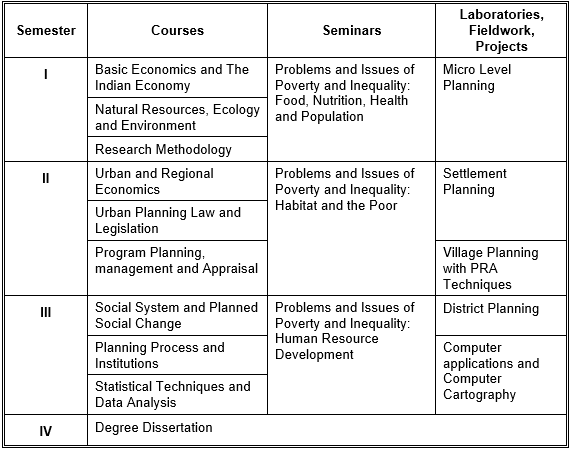
The curriculum of CDSA’s School of Development Planning (SDP) is designed to create a cadre of professionals who have the skills, knowledge and sensitivities in the areas of planned change at the local level, while not losing sight of pluralism in planning at the sub-national, national and global levels. Integrated regional development with an emphasis on decentralised governance and participatory management of common property resources is the basic area of focus for the course.
Students who graduate with a Master’s degree in Development Planning from the SDP are well grounded in the principals and practice of rural and regional development. They also have an inter-disciplinary training for dealing with critical issues (such as socio-economic, political and technical) pertaining to the planning and management of regions and settlements.
The objectives of the Masters Degree course are to produce professionally trained graduates who can:
- Comprehend the development process in the rural and urban contexts, with a special reference to the lower income and otherwise vulnerable groups.
- Design appropriate strategies and approaches to address development issues and problems.
- Formulate development projects and programs including schemes and investment plans that respond to these approaches.
- Develop and use appropriate monitoring, evaluation and management tools for implementing these projects and programs.
- Understand the working of financial, administrative and legal institutions involved in development efforts, especially on the backdrop of changing global economic scenarios.